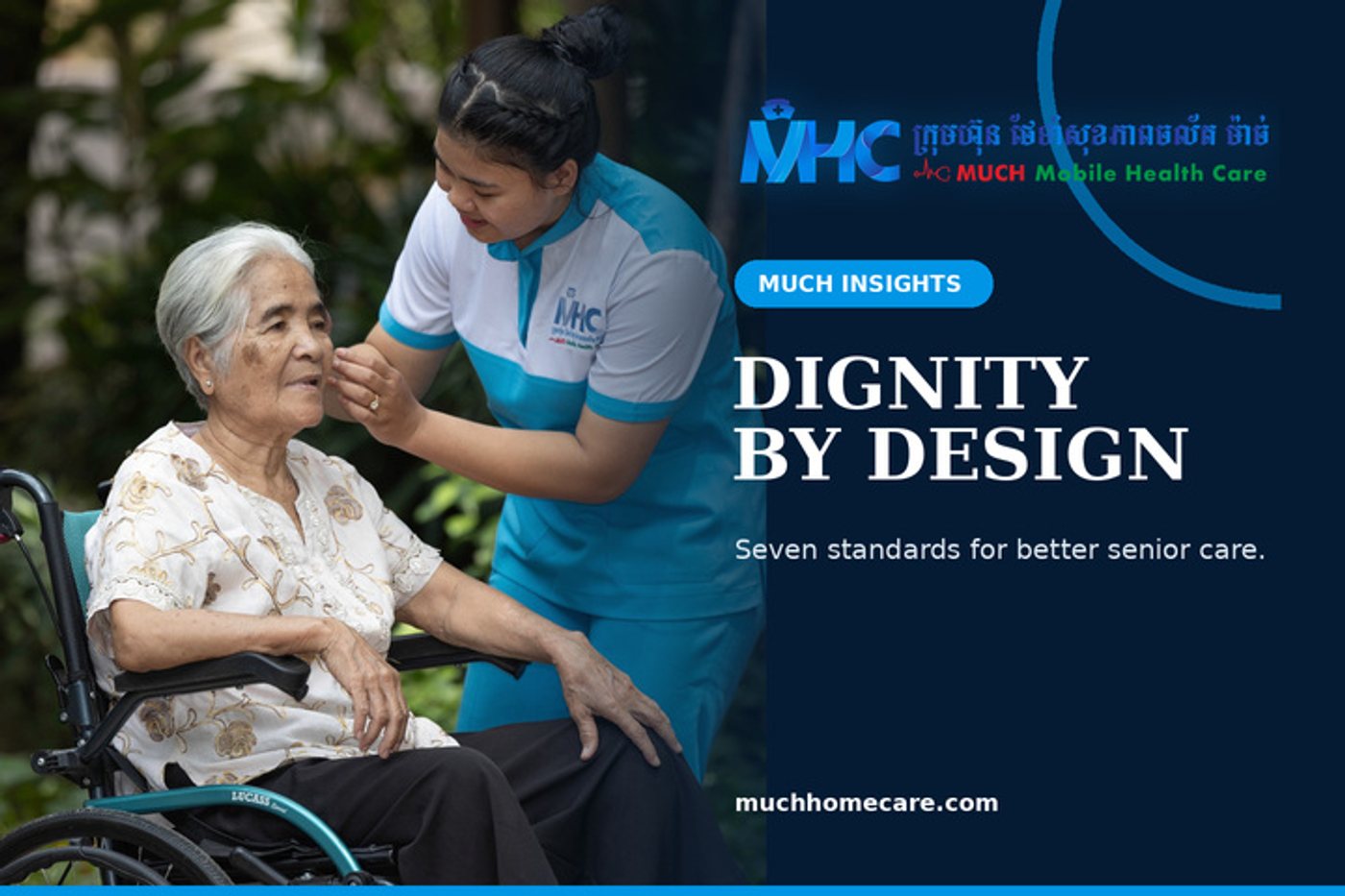
Dignity by Design: Seven Standards for Better Senior Care
High-quality senior care is more than completing tasks. Seven practical standards can help families and organizations judge whether care protects dignity, choice and continuity.
In senior care, quality is often described through staffing levels, clinical services, buildings or equipment. These matter, but they do not fully answer the most important question: does the care help an older person live with safety, dignity, choice and continuity?
The World Health Organization’s person-centred approach to older-person care starts with the individual’s needs, preferences and goals. Its recent guidance on integrated care and long-term-care quality also emphasizes coordination, safety and continuous improvement.
For families, hospitals, embassies, employers and other organizations that may recommend or coordinate care, these principles need to become practical questions. The following seven standards provide a useful starting framework. They are not a substitute for local regulation, licensing or clinical assessment, but they help decision-makers look beyond appearances.
1. The person is known, not only the condition
A diagnosis may explain part of a care need, but it does not describe the whole person. Good care asks about routines, language, food preferences, family roles, spiritual practices, sleep, privacy and what a good day looks like.
A plan should identify both risks and goals. “Prevent falls” is important, but so is “walk safely to the garden” or “join family lunch.” The older adult should participate in setting these goals whenever possible. If decision-making capacity is limited, authorized family members and professionals should still look for the person’s expressed preferences and previous values.
2. Roles and boundaries are clear
Senior care often involves family caregivers, professional caregivers, nurses, doctors, physiotherapists and facility staff. Confusion about responsibility creates gaps: one person assumes another checked the medication list, reported a symptom or arranged follow-up.
A strong care plan states who does what, what caregivers may and may not do, how concerns are escalated, and who supervises clinical tasks. Families comparing services should ask how non-medical support differs from nursing care. MUCH’s public explanation of Caregiver Support is one example of making scope and escalation boundaries visible.
3. Information follows the person
Older adults may move between home, clinic, hospital, rehabilitation and residential care. Each transition creates a risk of information loss.
Continuity requires an up-to-date care plan, medication list, allergies, recent changes, key contacts and clear follow-up instructions. Information should be shared only with authorized people and handled with appropriate privacy safeguards. A family should know whom to contact, what changes should be reported and how quickly the care team will respond.
When daily support and scheduled clinical care are both needed, a combined care plan can illustrate the value of coordinating caregiver, nursing, doctor and rehabilitation roles around one person rather than treating them as disconnected services.
4. Safety includes prevention and response
Quality care does not wait for an incident. It assesses risks such as falls, pressure injuries, dehydration, medication errors, infection and changes in mobility or cognition. It also prepares a response: who is called, what is documented, when urgent medical care is required and how the plan is reviewed afterward.
Safety should not become unnecessary restriction. Removing every choice in the name of protection can reduce independence and quality of life. Decisions should balance risk with the older person’s abilities, preferences and clinical condition.
5. Daily life still has meaning
Bathing, meals and medication may appear on a task list, but good care also protects identity and connection. Meaningful activity can be simple: choosing clothes, helping prepare food, reading, listening to music, walking outside or talking with family.
Activities should not be forced or used only to fill time. They should reflect the person’s interests, culture and energy. The same principle applies in a home or a residence. Families reviewing Senior Residential Care should ask how daily routines, social engagement, healthcare and family communication are personalized.
6. Families receive useful communication
More messages do not always mean better communication. Families need information that is timely, understandable and relevant: what changed, what was observed, what action was taken and what decision is needed.
Providers should define routine updates and urgent escalation separately. They should also confirm who is authorized to receive information. For families living abroad, a dependable communication process can be as important as the service itself.
Organizations that refer staff, clients or community members should ask how consent, privacy and escalation are managed before a need becomes urgent. The public overview of MUCH’s care services can support an initial discussion, but the final arrangement should follow an individualized assessment.
7. Quality is reviewed, not assumed
A care plan should change when the person changes. Regular review can examine health status, function, goals, incidents, feedback and whether the current level of support is still appropriate.
Quality management also requires learning. Providers should have a way to record concerns, investigate incidents, correct problems and improve processes. Decision-makers can ask:
- How often is the care plan reviewed?
- Who supervises caregivers and clinical staff?
- How are changes in condition escalated?
- How are complaints and incidents documented?
- How is feedback from the older person collected?
- How are family communication and privacy handled?
- What happens when needs become more complex?
A better standard is visible in everyday care
Dignity is not an abstract value. It appears in whether staff knock before entering, explain what they are doing, protect privacy, listen without rushing and offer real choices. Continuity appears in accurate records, reliable handovers and familiar people. Safety appears in both prevention and a clear response when something changes.
Families and organizations do not need to become clinical experts to ask better questions. They can begin with the person’s goals, then examine roles, coordination, safety, meaningful daily life, communication and review.
If an older adult’s needs span daily support and healthcare, a professional assessment can help identify the most appropriate combination of home care, home healthcare, membership or residential support. The correct model is not the one with the longest feature list. It is the one that is safe, coordinated and genuinely built around the person.
This article provides a general quality framework. It is not legal, regulatory or individualized medical advice. Service decisions should follow applicable Cambodian requirements and an assessment by appropriately qualified professionals.