From Hospital to Home: Why Safe Discharge Needs a Care System
A discharge document is not a recovery system. Cambodia’s families and institutions need clearer handovers, coordinated follow-up and practical support after a patient returns home.
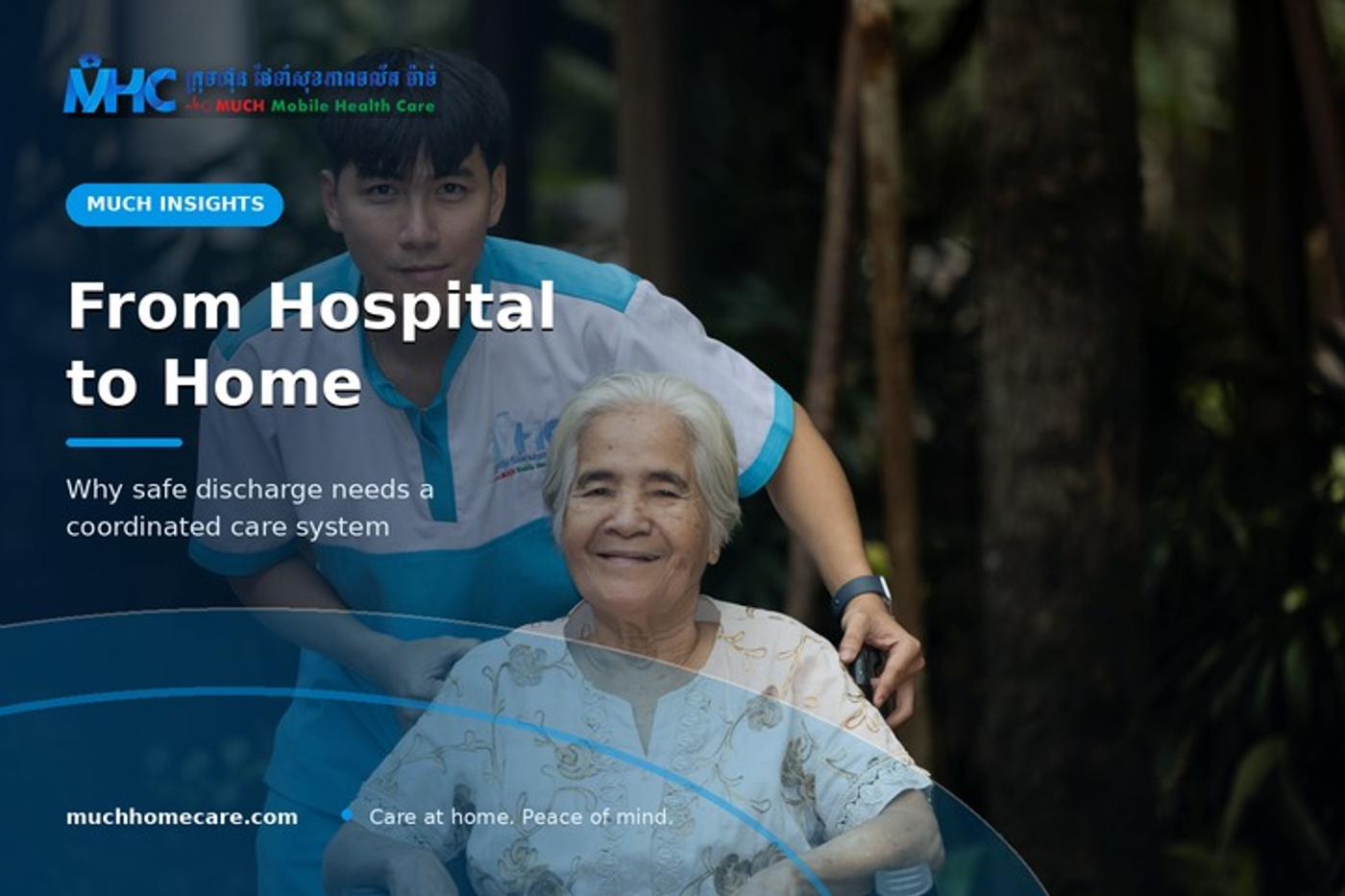
Discharge is a transition, not an endpoint
Leaving hospital is often treated as the end of an episode: the patient receives documents, medicines and a follow-up date, then returns home. In reality, discharge begins a new and vulnerable stage of care.
The setting changes, but the patient’s needs do not disappear. New medicines must be understood. Wounds may need attention. Mobility may be weaker than before admission. Equipment, transport, nutrition and follow-up appointments must be organised. Family members suddenly become part of the care system, often without formal training.
The World Health Organization warns that transitions of care can threaten patient safety because critical clinical information may be lost and coordination becomes more demanding. A good discharge process therefore cannot be measured only by whether paperwork was completed. It should be measured by whether the next stage of care is understandable and workable.
Why this matters for Cambodia
Cambodia’s population structure is changing. UNFPA’s 2025 policy brief, drawing on the 2024 Cambodia Inter-Censal Population Survey, reports that people aged 60 and older increased from 848,911 in 2008 to 1,750,785 in 2024—10.1% of the population.
An older population does not automatically mean greater dependence. Many people remain active and independent for years. But it does increase the importance of systems that can respond to chronic conditions, rehabilitation needs and changes in function without forcing every problem back into a hospital setting.
Cambodia’s National Policy on Ageing 2017–2030 also emphasises dignity, non-discrimination, gender equity and intergenerational family relationships. Those principles matter during discharge. Families remain central, but “family responsibility” should not become a substitute for clear information, professional guidance and access to appropriate support.
Four gaps can turn a discharge into a risk
1. The information gap
A hospital team may understand the diagnosis and treatment, while the patient, family, pharmacy and home-care team each receive only part of the picture. Unclear handwriting, technical language or missing instructions can leave basic questions unanswered.
A safe handover should state the current diagnoses, medicines, allergies, warning signs, follow-up plan, activity or diet instructions, wound or device needs and the professional to contact with questions. The patient should receive an explanation in language they understand—not only a document.
2. The medication gap
Admission often changes the medicine plan. The home may still contain older prescriptions, creating a risk that stopped medicines are restarted or similar products are taken together.
Medication reconciliation means comparing what the person was taking before admission with what they should take now, then communicating the final plan consistently. This requires clinical responsibility; it should not be left to a family member guessing from packaging.
3. The function gap
A patient may be medically stable but unable to walk, bathe, transfer, eat or use the toilet as before. If the home environment and family capacity are not considered, recovery can stall and the risk of falls, pressure injuries or caregiver exhaustion can rise.
WHO’s Integrated Care for Older People approach encourages person-centred assessment of physical and mental capacity, social-care needs and personal goals. This shifts the question from “Is the patient ready to leave?” to “What will this person need to live and recover safely in the next setting?”
4. The responsibility gap
When everyone is “helping,” nobody may be clearly accountable. The family may assume the hospital arranged follow-up. The hospital may assume the family will contact a clinic. A care worker may notice a change but not know who should receive the report.
Every transition needs a named coordinator or clearly agreed lead—whether that is a family member, clinician, case manager or care provider. Responsibilities should be specific: who confirms medicines, who monitors symptoms, who arranges transport, and who escalates concerns.
What a minimum safe transition should include
The exact plan will differ by diagnosis and level of need, but a reliable transition usually includes:
- A current written clinical summary and medicine list
- A plain-language conversation with the patient and family
- Confirmation that the home setting, equipment and caregiver capacity are suitable
- A follow-up schedule based on the patient’s condition
- Clear warning signs and escalation instructions
- A named person or service to contact with questions
- A plan for nursing, rehabilitation, personal care or medical review when needed
- Respect for the patient’s goals, preferences and consent
“Teach-back” can strengthen understanding: instead of asking, “Do you understand?”, a professional asks the patient or family to explain the plan in their own words. This reveals uncertainty before the patient reaches home.
Care coordination is an organizational responsibility
Hospitals cannot manage the home environment alone, and families cannot replace clinical systems. Safer transitions require cooperation across organizations.
Hospitals and clinics can improve the completeness and clarity of discharge information. Home healthcare providers can assess needs in the real environment, carry out agreed clinical care and report changes. Rehabilitation professionals can connect exercises to everyday movement. Employers can support staff members who are coordinating care for a parent or recovering family member. Embassies and international organizations can identify reliable local pathways for citizens, employees or beneficiaries who need continuing care in Cambodia.
The goal is not to create a complex bureaucracy around every discharge. It is to prevent avoidable uncertainty at predictable points of risk.
Design the plan around recovery, not services
A person-centred transition begins with the outcomes that matter to the patient. One person may want to walk safely to the bathroom. Another may want to manage pain well enough to sleep, return to work gradually or avoid another exhausting journey to hospital.
Services should then be matched to those goals. Depending on clinical assessment, support might involve home nursing, a doctor home visit, physiotherapy and rehabilitation, caregiver assistance or a coordinated combination. More service is not always better; the right plan is the least intensive plan that safely meets the person’s assessed needs, with the ability to adjust when those needs change.
MUCH publicly describes these types of home-based services, including Home Nursing Care, Doctor Home Visits, Home Physiotherapy & Rehabilitation and Combined Care Plans. Any transition plan should be confirmed after assessment and coordinated with the treating medical team.
A practical leadership question
For healthcare leaders, employers, embassies and NGOs, the most useful question is not “Do we have a discharge process?” It is:
Can the patient and the next care team safely act on the plan tomorrow morning?
If the answer depends on missing information, informal personal contacts or a family member interpreting clinical instructions alone, the transition is not yet complete.
Cambodia has an opportunity to strengthen community and home-based care as the population changes. Building dependable bridges between hospital, home and family will protect dignity, support recovery and make better use of professional care across the system.
This article provides general information, not an individual discharge plan. Patients should follow instructions from their treating clinicians and seek urgent medical care if severe or rapidly worsening symptoms occur.