Cambodia Is Ageing: Why Better Care Systems Must Start Now
Cambodia still has a young population, but its age structure is changing. Preparing now means building coordinated care that protects independence, supports families and strengthens society.
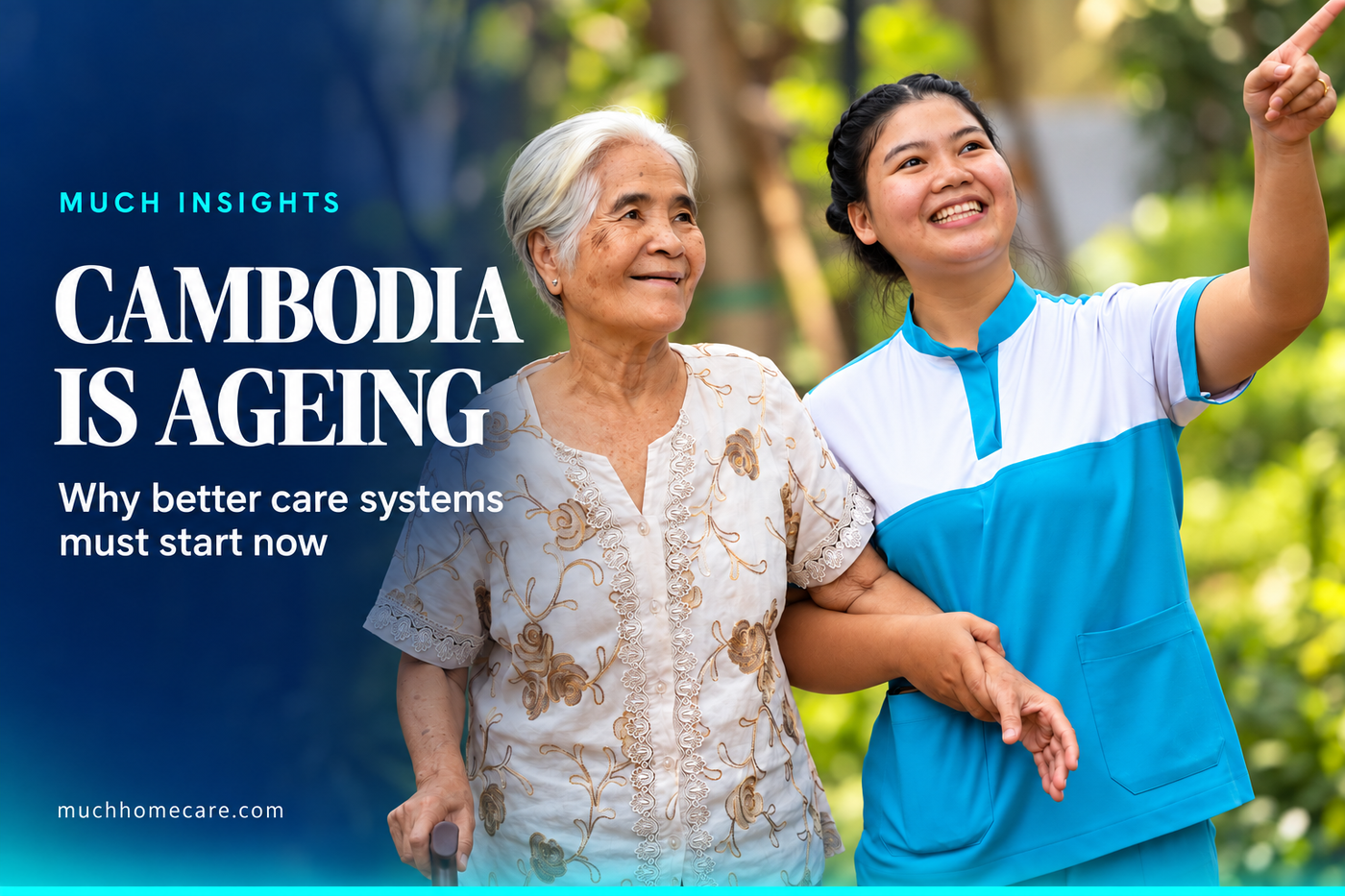
Cambodia’s population story is changing
Cambodia remains a relatively young country, with a large working-age population supporting economic development. But the direction of change is clear: people are living longer, family structures are evolving and the number of older people will increase.
In July 2026, UNFPA Cambodia described the country’s current demographic position as a valuable opportunity. Investing in health, education, employment and social protection today can build a stronger society that is better prepared to care for every generation as the population ages.
A separate UNFPA factsheet published in August 2026 highlighted Cambodia’s shifting age structure, the socio-economic implications of population ageing and the need for evidence-based long-term planning.
This is not only a government-policy issue. Population ageing will affect families, employers, healthcare providers, residential-care operators, insurers, communities and anyone designing services for Cambodia’s future.
The question is not simply whether Cambodia will need more care. It is what kind of care people should be able to receive.
Ageing well means more than treating disease
Ageing is sometimes discussed only in terms of illness and dependency. That view is incomplete.
The World Health Organization defines healthy ageing around functional ability: whether people can meet their basic needs, make decisions, remain mobile, maintain relationships and contribute to their communities. A person does not need to be completely free from disease to age well. Conditions that are identified and properly managed may have a much smaller effect on everyday life.
That distinction matters.
A healthcare system focused only on acute illness may respond after a crisis. A care system designed for healthy ageing also asks:
- Can this person move safely at home?
- Are they taking medication correctly?
- Are they eating and drinking adequately?
- Can they attend appointments?
- Are changes in memory, mood, hearing or vision being noticed?
- Does the family understand the care plan?
- Is the person socially connected?
- Is the home environment suitable?
- Who will coordinate care if needs become more complex?
These questions connect medical care with everyday life.
The first shift: from isolated visits to continuity
Older adults often live with more than one health concern. They may see different doctors, receive multiple prescriptions and depend on family members to remember instructions.
When care is fragmented, important information can be lost between providers, patients and relatives. Families may receive advice but have no clear system for carrying it out at home.
Continuity does not necessarily mean constant medical intervention. It means that care has direction:
- There is an updated understanding of the person’s condition
- Responsibilities are clear
- Changes are documented
- Follow-up happens when needed
- Family communication is organized with the patient’s permission
- Different professionals work from a compatible care plan
WHO’s Integrated Care for Older People approach recommends coordinated, person-centred care that can identify declines in physical or mental capacity, assess social-care needs and support personalized care planning.
Cambodia can adapt these principles to local family structures, resources and cultural expectations.
The second shift: from family responsibility to family partnership
Cambodian families have traditionally played a central role in caring for older relatives. That commitment remains valuable, but modern pressures can make the work more difficult.
Adult children may work long hours, live in another province or move abroad. A relative may want to help but lack the clinical knowledge to manage wounds, medication, mobility problems or recovery after hospitalization.
Professional care should not replace the family’s role. It should make that role safer and more sustainable.
A strong family-professional partnership can include:
- Teaching relatives how to support the care plan
- Explaining which tasks require a qualified professional
- Providing clear channels for questions
- Sharing authorized care updates
- Recognizing caregiver stress before it becomes burnout
- Planning respite or alternative support when the primary caregiver is unavailable
- Including the older person in decisions
Families should be partners, not unpaid substitutes for an entire healthcare system.
The third shift: from one setting to a continuum of care
Older people do not all need the same environment.
Some can live independently with periodic health monitoring. Others need caregiver support with meals, mobility or personal care. Some require regular nursing, physiotherapy or doctor follow-up. A smaller group may need a supportive residential environment or intensive medical care.
The right model is therefore not “home care versus residential care.” Cambodia needs a continuum that allows support to change as the person’s condition changes.
That continuum may include:
- Preventive health assessments
- Doctor consultations
- Home nursing
- Physiotherapy and rehabilitation
- Daily caregiver support
- Short-term respite care
- Senior wellness and social activities
- Long-term residential support
- Palliative and supportive care
- Coordination during transfers between home, clinic and hospital
The aim should be to provide the least restrictive safe option while preserving dignity, choice and family connection.
The fourth shift: from reacting to crises to planning earlier
Families often begin discussing professional care after a fall, hospitalization or sudden decline. At that point, decisions must be made quickly and emotionally.
Earlier planning creates more options.
An older adult can explain where they prefer to receive care, who may access their health information and which family members should be involved. The family can review the home environment, identify nearby support and understand the difference between non-medical caregiving and clinical nursing.
Organizations also benefit from earlier planning. Employers may have staff who are caring for ageing parents while balancing full-time work. Embassies and international organizations may need reliable pathways for medical coordination. Housing developers may need to consider accessibility. Healthcare providers need staff trained in geriatric, rehabilitative and person-centred care.
Population ageing touches many sectors long before a person enters a hospital.
The fifth shift: from viewing care as a cost to viewing it as infrastructure
Good care creates value that is difficult to capture in a single number.
It can help an older person remain independent for longer. It can give an adult child enough confidence to continue working. It can reduce confusion after hospital discharge. It can help professionals recognize deterioration earlier. It can provide companionship and protect dignity.
Care infrastructure includes trained people, clear standards, responsible supervision, information systems, accessible environments and coordination between health and social support.
Cambodia’s current demographic position provides time to develop this infrastructure deliberately rather than waiting for demand to become overwhelming.
What preparation can begin now?
For families
Begin conversations before urgent care is needed. Maintain basic medical information, review the home for safety risks and identify who will coordinate decisions if circumstances change.
For healthcare providers
Develop services that connect assessment, treatment, rehabilitation, daily support and follow-up. Measure quality not only by the number of visits delivered, but also by patient safety, function, communication and experience.
For employers and organizations
Recognize that employee wellbeing can be affected by caregiving responsibilities. Consider flexible support, health education, workplace assessments and reliable referral pathways.
For policymakers and communities
Include older people in planning. Improve accessibility, strengthen the care workforce and build systems that protect people across income levels and locations.
For care organizations
Invest in training, supervision, safeguarding and transparent communication. Technology can support coordination, but it should remain simple enough for patients, relatives and frontline staff to use confidently.
Care should protect the life a person values
Cambodia’s ageing future should not be framed only as a burden. Longer lives can mean more years of experience, family participation, mentorship and contribution.
The real challenge is ensuring that longer life is supported by systems that respect independence and respond when needs change.
At MUCH, our direction is to connect care at home, senior wellness, medical support and residential care around the person—not around a single service. Families can explore Care at Home, ElderlyCarePlus and Senior Residential Care according to assessed needs.
Preparing for population ageing begins with a simple principle: every older person should be seen as a whole person, not a collection of medical problems.